By Megan Schupp
Applying for an NIH fellowship can feel like decoding a foreign language with all the jargon and acronyms. All the terms- F30, F31, F32, NRSA, study section, SRA, PO- can leave someone scratching their head in frustration. However, securing one of these awards is one of the most powerful ways to fund your training, build your CV, and signal independence to future employers, whether you're headed for academia, industry, or beyond. At a recent iJOBS workshop, Dr. Lauren Aleksunes walked trainees through exactly how to navigate the process. Drawing on her extensive experience as an NIH grant reviewer, she demystifies the grant application process with step-by-step guidance to help trainees craft compelling and competitive grant applications.
What is the NRSA, and who is eligible to apply?
The National Research Service Award (NRSA) fellowships are training awards targeted towards
supporting biomedical, behavioral, and clinical researchers through predoctoral and postdoctoral stages. Recipients of NRSA fellowships receive a living stipend, support for tuition and fees, and additional funding to offset training-related costs, such as health insurance and research expenses. NRSA support is available for up to five years for predoctoral trainees and up to three years for postdoctoral trainees. All 27 NIH institutes offer NRSA fellowships for trainees at different career stages. There are two categories to look for:
- Individual NRSA Grants:
- Predoctoral Fellowship:
- F30 is for dual-degree students (ie., MD/PhD, DDS/PhD, etc)
- F31 is for PhD students
- Postdoctoral Fellowship (F32)
- Predoctoral Fellowship:
- Institutional NRSA Grants: These awards are given to institutions that support multiple predoctoral and/or postdoctoral trainees
Rutgers has a myriad of institutional grants available at both the predoctoral and postdoctoral levels at this link here. Before starting the application process, check your eligibility. Applicants must be U.S. citizens, non-citizen nationals, or permanent residents. Use this link to learn more about current guidelines.
What NIH institutes should I apply to?

Once you've confirmed your eligibility, you will need to determine which of the 27 NIH institutes you should apply to. The best way to find a home for your research is to use reporter.nih.gov. This will allow you to see what grants are getting funded.
Who are the key players in the NIH application process?
There are two people that you should be familiar with for NIH applications: the scientific review officer (SRO) and the program officer (PO). Each institute has SROs and POs assigned to different research areas. The SRO works to identify peer reviewers, coordinate study section reviews, and provide a summary back to the applicants. The PO helps identify specific research areas that align with the values of their NIH institute. Once you have identified the institute you are applying to, Dr. Aleksunes suggests reaching out to the PO two months in advance with a well-crafted aims page to schedule a meeting.
How do I write an NIH fellowship application?
Specific Aims Page
The Specific Aims Page will act as the trailer for your research strategy “movie” and should be around one page long. Dr. Aleksunes recommends structuring this section by defining the broader research problem, identifying the knowledge gap, explaining the proposed approach, and concluding with the central hypothesis.
- Opening Paragraph: A strong hook can capture the reviewer’s attention by introducing the research topic and explaining its significance. One way to achieve this goal is to cite a relevant statistic or fact that underscores the problem's importance. Use follow up sentences to provide context, identify the key knowledge gap, and explain why addressing this gap is important.
- Central Paragraphs: The central paragraphs are used to describe how you will fill this gap of knowledge. It should mention a long-term goal, a central hypothesis, a rationale, and preliminary data. You must connect broader concepts to your specific research question.
- Aims: The aims should be two independent but related objectives. Avoid making Aim 2 dependent on the success of Aim 1 — reviewers see this as a red flag. Dr. Aleksunes suggests that the aims should provide a hypothesis and a basic experimental strategy.
- Closing Paragraph: The closing paragraph should clearly state the novelty of the research with a focus on human health. Think about the impact. Use your research to conclude your specific aims page.
Research Strategy
The Research Strategy is the most comprehensive section of the application. It is typically six pages long, and can be broken down into the following sections:
|
Section |
Suggested Length |
Purpose / Key Content |
|
Preliminary Data |
½–⅔ page |
Establish feasibility. Begin by summarizing the key findings generated by you or your lab. Starting with preliminary data helps identify the most important evidence supporting the proposal and provides a foundation for developing the approach section. |
|
Approach |
3½–4½ pages |
Present the research plan, rigor, and feasibility. Typically organized around 2–3 aims. For each aim, address: (1) Rationale, (2) Rigor (e.g., controls, sample sizes, statistical tests), (3) Expected Outcomes, and (4) Pitfalls and Alternative Strategies. |
|
Innovation |
3–5 sentences |
Define the unique edge of the proposal. Explain what makes the proposed research innovative, focusing on advances in concept, methodology, or both. |
|
Significance |
½–⅔ page |
Answer the “So What?” Identify critical gaps in the field and explain why addressing these gaps will meaningfully advance the understanding of human health. |
|
Conclusion |
⅓ page |
Recap feasibility, impact, and innovation. Reinforce why the proposed research is feasible, what impact it could have on the field, and what its key innovations are. |
Keep in mind that the NIH fellowship is a training grant. They are roughly one-third science, one-third training, and one-third PI recommendations broken into different sections (see below). Do not focus only on perfecting the research approach! The training plan is equally important and demonstrates your path toward becoming an independent researcher. The following sections describe the major components of the fellowship application and explain how each contributes to demonstrating your potential to become an independent biomedical researcher.
Candidate Goals, Preparedness, and Potential (3 pages)
- Overall Training Goals: Define how the proposed research training plan is connected to your career goals in the biomedical research workforce and why you are interested in a career in biomedical research.
- Candidate’s Preparedness: Highlight how relevant activities such as coursework, internships, or conferences have contributed to your scientific development. Additional activities that demonstrate a commitment to a career in the biomedical sciences, such as service, teaching, and outreach activities, can be included in this section.
- Candidate’s Self-Assessment: Identify two to four characteristics that contribute to your success as a researcher, along with two to four areas of development that will help you achieve the research training and career goals.
- Scientific Perspective: Focus on why your field of science is important and how your project will advance the field. It is important to highlight an unresolved scientific question in your field and how research may solve it.
Training Activities and Timeline
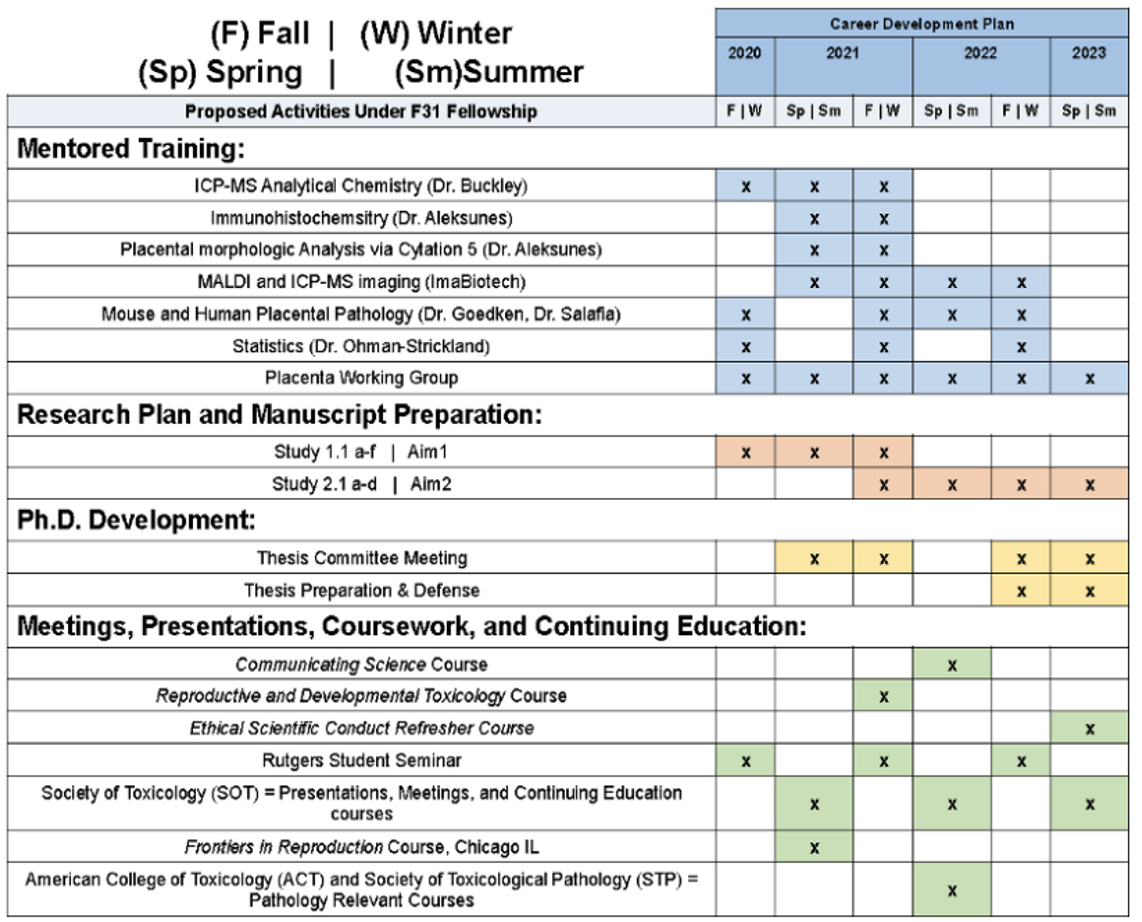
The training plan should be tailored to your goals and well-integrated with your identified areas for development. To make your application stand out, Dr. Aleksunes recommends creating a Gantt chart to track activities to be completed each year. Within this chart, you can include meetings and coursework that you intend to take throughout the year. For example, you can include classes from MBL Advanced Research Training at Woods Hole to show that you plan to improve your training.
Securing an NRSA fellowship requires more than a strong research idea. It demands a compelling vision for your scientific training, a well-designed research plan, and a clear demonstration of your potential as an independent investigator. By carefully selecting the appropriate NIH institute, engaging with program officers early, and thoughtfully developing each component of the application, applicants can create a competitive proposal that highlights both scientific rigor and career development. As emphasized by Dr. Lauren Aleksunes, investing time in strategic planning, strong mentorship, and clear scientific storytelling can significantly strengthen an application and position trainees for future success in biomedical research.
For readers who want to learn more, the following resources provide additional guidance and reference material:
- NIH RePORTER
- Official Announcement
- Gradfund
- Training Opportunities for helping writing the F31
- Graduate School Resources
This article was edited by Junior Editor E. Beyza Guven and Senior Editor Antonia Kaz.