By Matthew Brown
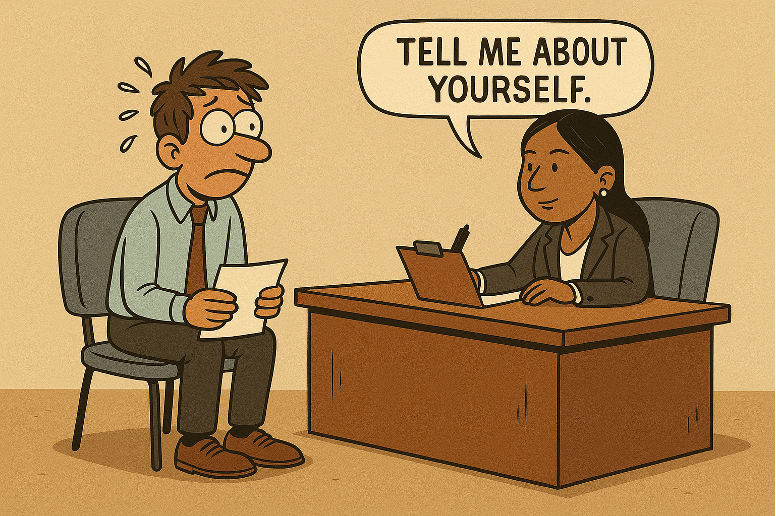
For scientists, the hardest part of the job search isn’t listing our accomplishments; it’s explaining them in a way that resonates outside academia. That was the core message of the iJOBS workshop, From Bench to Offer: Mastering the Art of the Interview, presented by Dr. Janet Alder, Assistant Dean for Graduate Students (SGS), Assistant Vice Chancellor for Postdoctoral Affairs at Rutgers Health, and Associate Professor of Neuroscience and Cell Biology at RWJMS, along with Dr. Rudrani Gangopadhyay, Senior Assistant Director of Graduate Student Career Pathways, on 18 February 2026. It was not just a list of tips; it was a blueprint for translating the way scientists think (hypothesis-driven, data-aware, and collaborative) into interview answers that make sense to hiring managers. Below is a recap and a field-tested playbook to turn your experiences into compelling, confident stories.
Why interviews feel hard (especially for scientists)
To use that playbook effectively, it helps to understand why interviews feel hard. Interviews compress years of work into minutes of conversation. In academia, we are trained to lead with nuance and caveats; in interviews, we are asked for clear decisions, measurable outcomes, and forward motion. Add in multi-hour panel days, a mix of behavioral and technical prompts, and the expectation to be personable while thinking on your feet, and it is natural to feel anxious. In that environment, having a simple way to organize your answers becomes essential. Structure helps make your answers clearer without changing who you are. Think of it this way: if someone asks, “Tell me about a challenge in your research,” most scientists start explaining the biology or the experiment. A framework offers a clearer path. Instead of narrating your whole dissertation, you choose one challenge, name the obstacle, describe your action, and end with a measurable impact. The content is still yours because the structure simply highlights it more clearly.
Answer the three questions behind every question
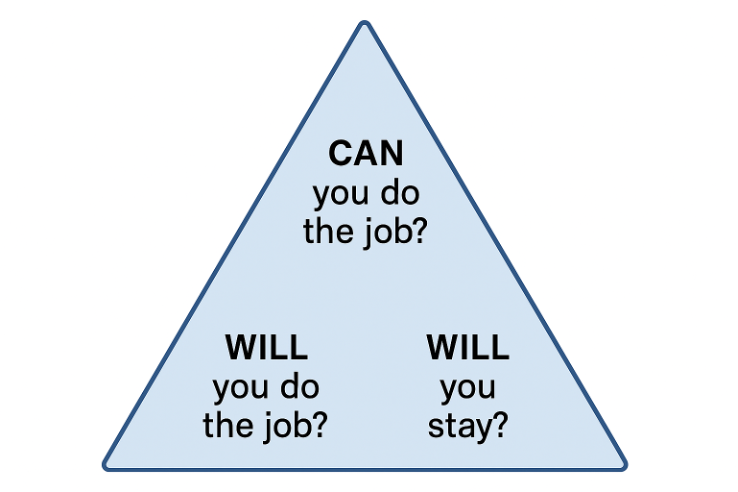
Once you understand why interviews feel hard, the next step is to understand what interviewers are evaluating. Every interview question can be related to one question: “Why should we hire you?” Every prompt, whether it is "Walk me through a project," "Tell me about a challenge," or even "Why this company?” rolls up to three main concerns: Can you do the job? Will you do the job? Will you stay?
- Can you do the job?
- Experimental design rigor
- Troubleshooting ability
- Statistical literacy
- Technical platform expertise
- Reproducibility mindset
- Documentation habits
- Regulatory awareness (familiarity with GLP, GMP, FDA, if relevant).
- Will you do the job?
- Motivations beyond academia
- Comfort with deadlines
- Collaborate across functions
- Openness to feedback
- Ability to pivot when data fails
- Will you stay?
- Mission-alignment
- Understanding of commercialization timelines
- Realistic about moving away from independent research
To put these categories into practice, you can translate your research into skills and impact.
Translate your science into skills + impact (not topic)
Try this three-level translation to switch registers without dumbing anything down:
1) 15 seconds (elevator version): One line that names your domain and general approach.
2) 1 minute (industry translation): Methods you designed/optimized, data you analyzed, and cross-functional work you led.
3) Problem–Solution–Impact (PSI): Name the obstacle, the specific actions you took, and how you measuredimprovement.
Example (wet lab to industry):
- Identity: "My research focused on identifying small molecule inhibitors targeting inflammatory pathways in autoimmune disease using CRISPR-based screening and in vivo validation."
- Translation: "I designed and optimized CRISPR screening assays, analyzed high-throughput datasets, and led cross-functional collaborations to validate therapeutic targets in mouse models."
- PSI: "The key challenge was inconsistent gene-editing efficiency, so I redesigned the sgRNA selection pipeline and improved editing success by 40%."
Language choices matter. Swap academic verbs for industry verbs:
|
Academic |
Industry |
|
Researched |
Analyzed, developed, implemented, designed, standard operating procedures |
|
Taught |
Trained, facilitated, delivered professional training |
|
Published |
Produced deliverables, created documentation, generated insights |
|
Designed experiments |
Managed projects |
|
Presented at conferences |
Presented reports to stakeholders |
|
Collaborating with peers |
Cross-functional teamwork, negotiation, conflict resolution |
You are the same scientist, just speaking the audience’s dialect.
Open strong with a 60-second positioning statement
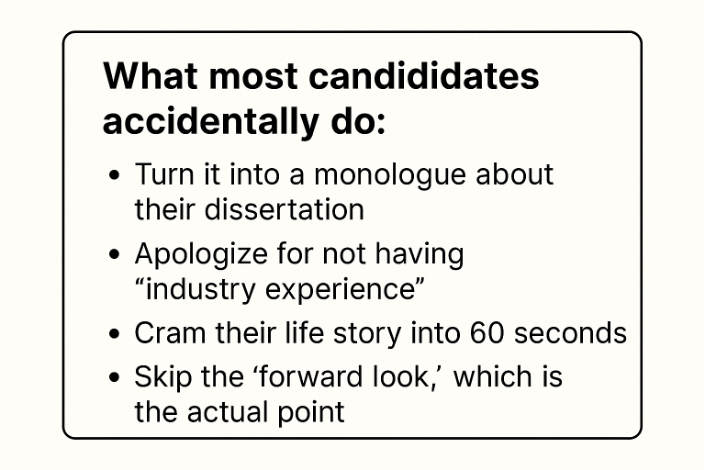
Most interviews open with a broad prompt before diving into technical or behavioral questions. When they say, "Tell me about yourself," they want a concise positioning statement that makes it obvious why you fit this role. Use the 4-part frame: Identity → Core skills → Impact → Forward look
Template:
- Identity: "I am a [role] at [institution] working on [broad area]."
- Core skills: "My work centers on [methods/platforms/analytics], plus [collaboration/leadership angle]."
- Impact: "Recently, I [measurable outcome or process improvement]."
- Forward look: "I am excited to apply [capabilities] to [company/team mission]."
Example:
“I am currently completing my PhD in Biomedical Sciences, where I have focused on identifying novel therapeutic targets in autoimmune disease. My research combines CRISPR-based functional screening with in vivo validation models, and I have led collaborations across computational and wet lab teams. One of my key contributions was redesigning our gene-editing optimization workflow, which improved reproducibility across experiments and accelerated downstream validation. Through this work, I have realized I am most energized by collaborative, milestone-driven research environments, which is why I am excited about roles in biotech where I can contribute to translational programs with clear therapeutic impact.”
After introducing yourself clearly, interviews usually transition into behavioral questions designed to reveal how you work with others and respond under pressure.
Turn behavioral questions into growth stories with the STAR‑L method
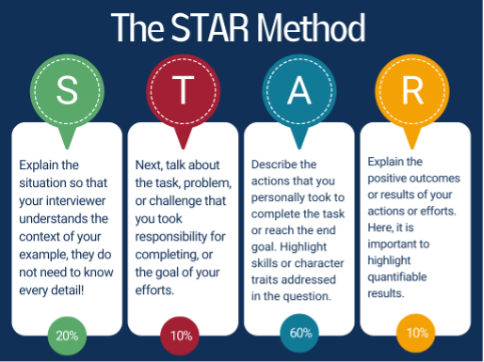
Behavioral interview questions often ask you to describe how you handled a situation in the past. A common way to organize these answers is the STAR method: Situation, Task, Action, Result. The framework helps you give a focused example instead of summarizing an entire project.
Some candidates add a final step—Learning—to show what they took away from the experience. This extended version, sometimes called STAR-L, can be especially useful for scientists because it highlights reflection and improvement, not just the outcome.
Use STAR‑L—Situation, Task, Action, Result, Learning—and quantify what you can. For example:
Question: Tell me about a time an experiment failed.
- Situation: I was validating a protein target using western blot analysis during my second year.
- Task: Repeated experiments showed inconsistent band intensity across replicates.
- Action: I systematically reviewed variables, including antibody lot numbers, blocking conditions, and sample preparation protocols. I discovered that the primary antibody had low specificity. I validated a new antibody using positive and negative controls and redesigned the protocol.
- Results: The revised protocol reduced variability by approximately 30%, and the optimized method became the lab standard for subsequent experiments.
- Learning: I learned to approach experimental failure systematically rather than assuming operator error, and I now proactively validate critical reagents early in project design.
In parallel with behavioral questions, many science-focused roles include technical prompts. These are not quizzes. They are opportunities to show how you think. The same clarity applies to technical interviews.
Make the technical interview a conversation, not an exam
Think aloud. Ask clarifying questions. State assumptions, controls, acceptance criteria, risks, and a minimal viable experiment. If you do not know, say what you would check, where you would look, and how you would triage time and cost.
What they are testing:
- Logical flow
- Controls
- Statistical reasoning
- Practical feasibility
- Awareness of regulatory considerations
Beyond structured questions, interviewers also look for judgment and self-awareness.
Difficult questions you should prepare answers for
- Why are you leaving academia?
- Talk about being energized by collaborative, fast-paced environments where research directly translates to patient outcomes.
- What are your weaknesses?
- Talk in a way that shows growth in matters of delegation, over-explaining, or time management in multi-project settings.
- What salary are you looking for?
- Research the ranges for similar roles and your experience on Glassdoor, Levels, or Bioscape.
Interviews are also a chance for you to assess fit.
Smart questions that show you are thinking like a teammate
When they ask, "Do you have questions for us?" it is not small talk; it is cultural fit.
Examples:
- What metrics define success for this role in the first 6 months and year?
- Which decisions are made in the team, and which are made at the program level?
- How do research and regulatory teams collaborate?
Even after the interview ends, you are still communicating your professionalism. A concise follow-up helps reinforce your fit.
Follow up like a professional (within 24 hours)
Send a thank‑you that is short, specific, and value‑forward: one line of gratitude, one callback to the conversation, one sentence connecting your skills to their needs, and a clear close.
Template:
Subject: Thank you — [Position Title] Interview
Thank you for the opportunity to discuss how my experience designing CRISPR-based screening platforms could contribute to your oncology pipeline. I especially appreciated learning about your translational strategy.
Final thoughts
The workshop’s central message was that scientists already think the way strong interviewers need to think. They just need a new way to narrate it. If all of this feels like a lot, that is completely normal. Interviews feel unfamiliar, not because they are a different you, but just because they are a different format. Interviews reward clarity more than charisma. If you bring structure to your stories and curiosity to your questions, you will not have to manufacture confidence. It will follow from preparation. For scientists, that is good news. We already know how to iterate, quantify, and document. The shift is learning to narrate that work for a new audience. Start with the three employer questions, translate your research into skills and impact, and practice out loud. That is how you move from bench to offer.
This article was edited by Senior Editor Janaina Cruz and Senior Editor Joycelyn Radeny.