By Megan Schupp

Time management is an essential skill in academia—where overwork is often glorified, and balancing research, classes, teaching, and a personal life can feel like a juggling act. However, time management is not just about squeezing more work into your day. The Time Management and Life Balance workshop was designed to address why time management and work-life balance matters. This article covers the main takeaways and offers guidelines to find your optimal work routine.
Balancing multiple projects quickly leads to the feeling of being overwhelmed and exhausted. Effective time management helps alleviate these feelings by establishing protected time for decompression and recovery. It accounts for your energy availability by scheduling work according to your optimal hours—for example, focusing on readings and emails when you have the most energy and doing experiments when you need something more active than passive.
Time management is about protecting your mental health, making intentional choices about your priorities, and creating a sustainable rhythm that lets you grow and thrive. The optimal work routine takes about three weeks to establish, but a dependable routine enables you to make the most of your time. A licensed counselor with extensive community and social work experience, Dana Simons, encouraged participants to redefine success and use the following strategies to establish the optimal work-life balance routine.
Reflect on Top Values
Effective time management starts with knowing what matters to you. During the workshop, Dana encouraged attendees to pause and identify their top values, such as family, health, research, financial stability, creativity, or community. After identifying these values, compare these values with how their time was currently being spent. This reflection often revealed a mismatch. For example, we might say we care about sleep, relationships, or long-term career development, but our calendars are only packed with deadlines and urgent tasks. Recognizing this gap is powerful. It helps us make more intentional choices about what we say “yes” to and reminds us that a well-managed schedule should reflect our priorities, not just our obligations.
Map Calendar Time
After clarifying values, the workshop moved into a practical “time audit.” Participants were asked to track how they spend their time over several days, from classes and research to social media, and rest. The goal wasn’t to judge ourselves, but to see our routines clearly and identify patterns—perhaps emails eat up more hours than we realized, or deep focus work is done during the most distracting times of the day. With this awareness, we can start to reorganize and turn vague stress (“I’m always busy”) into clear data.
Key insights:
- Group similar tasks into time blocks
- Schedule focused work when our energy is highest
- Protect time for sleep, meals, and movement
Employ Time Management Tools
There were two time management tools introduced in the workshop:
The Eisenhower Method
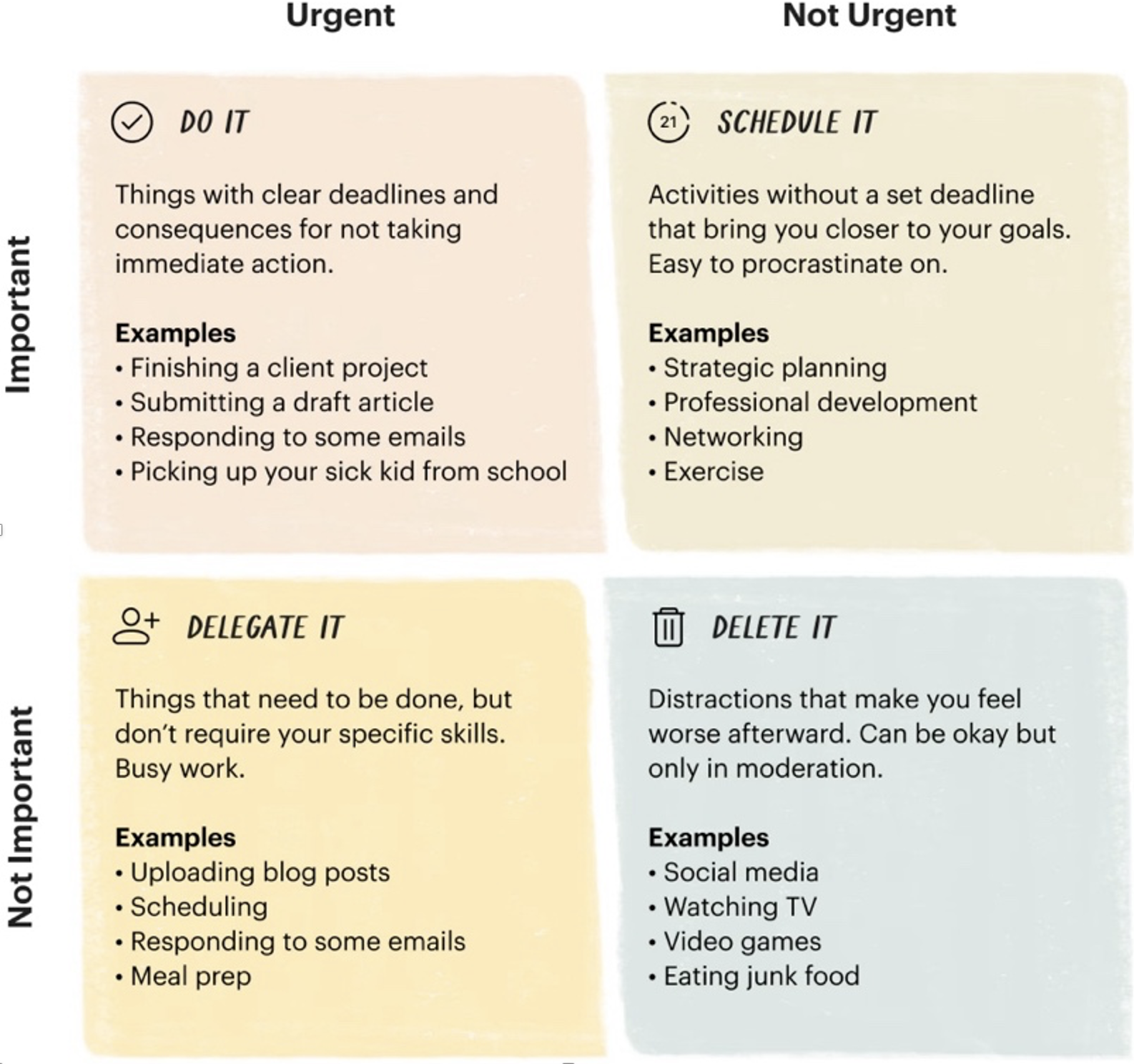
The Eisenhower Matrix is a time management and prioritization tool designed to help individuals and teams make informed decisions about where to focus their attention. This method is based on the idea that what is important is seldom urgent, and what is urgent is seldom important. The matrix divides tasks into four categories according to their urgency and importance. Tasks that are both urgent and important should be addressed immediately, whereas tasks that are important but not urgent should be scheduled for a later time. Tasks that are urgent but not important are best delegated, while tasks that are neither urgent nor important should be eliminated. By organizing tasks in this manner, the Eisenhower Matrix can improve productivity, reduce stress, and help allocate time to activities that align with long-term goals rather than short-term distractions.
For a graduate student, tasks in the DO IT column could be writing an outline for a manuscript with a set deadline or completing time-sensitive experiments. In the SCHEDULE IT column, tasks such as reading papers, working on a review article, or searching for new fellowships. For the DELEGATE IT column, tasks such as answering emails and planning meetings with potential collaborators. Lastly, for the DELETE IT column, for me, it is using social media or watching too much TV. This method of time management helps keep pace with the important tasks.
Key insight:
- If you never make time for the “Important but Not Urgent” tasks, your life becomes one long emergency
Pareto Principle (80/20 Rule)
The Pareto Principle states that roughly 20% of our efforts often generate 80% of our results. This concept highlights the importance of identifying and prioritizing key tasks that drive progress, such as key experiments, writing sections of a paper, or preparing a job application. We should also recognize, reduce, batch, or eliminate “busy work.” These are tasks that consume time but add little value.
How to Apply the Pareto Principle (80/20 Rule):
1. Identify the vital 20% of tasks that create 80% of results. The high impact tasks:
- Designing and running key experiments or simulations
- Writing core sections of papers such as the methods, results, discussion
- Developing skills directly tied to your career (i.e., coding, statistical methods)
2. Prioritize high-impact tasks first. If your primary objective is to write a research paper, you may have the following tasks to complete:
- Format references
- Write the results and discussion section
- Run one last critical experiment to tie the paper together
- Tweak the figure fonts to match the requirements for submission
According to the Pareto Principle, the critical experiment and writing core sections of the paper are the 20% that generate 80% of the paper’s value. When creating a schedule, you should schedule these tasks during peak productivity hours. Lower-impact tasks such as formatting the references and fine-tunning the figures can be postponed until the 20% is completed.
3. Recognize and reduce “busy work”.
- Constantly checking email or slack
- Re-running analyses that don’t change conclusions
- Perfectionism on formatting too early
4. Batch similar low-value tasks together. Routine tasks can be completed in dedicated time blocks:
- Answer emails at specific times once or twice a day
- Batch literature downloading and citation management weekly
- Handle administrative duties or forms in one scheduled session.
5. Eliminate or delegate what doesn’t add value.
- Use reference managers instead of manual citation formatting
- Create templates for posters, C. Vs, and papers
- Delegate tasks when possible, such as shared lab responsibilities
Key insight:
- Focus on results, not activity.
Together, the Eisenhower Method and the Pareto Principle focus on the tasks that matter, so your time and energy support progress toward your goals and contribute to a more balanced life.
Overall, the iJOBS and CAPS Time Management and Life Balance Workshop provided valuable strategies for managing the many demands of academic life. By combining reflective exercises with practical tools like the Eisenhower Matrix and Pareto Principle, participants learned how to align their daily actions with their core values and long-term goals. The workshop emphasized that success isn’t about constant busyness, but about making intentional choices that protect your well-being while maintaining productivity. Ultimately, attendees left with a clearer understanding of how to build sustainable routines that support both professional growth and personal balance.
This article was edited by Junior Editor Joshua Stuckey and Senior Editor Antonia Kaz.