By Xinyi Miao
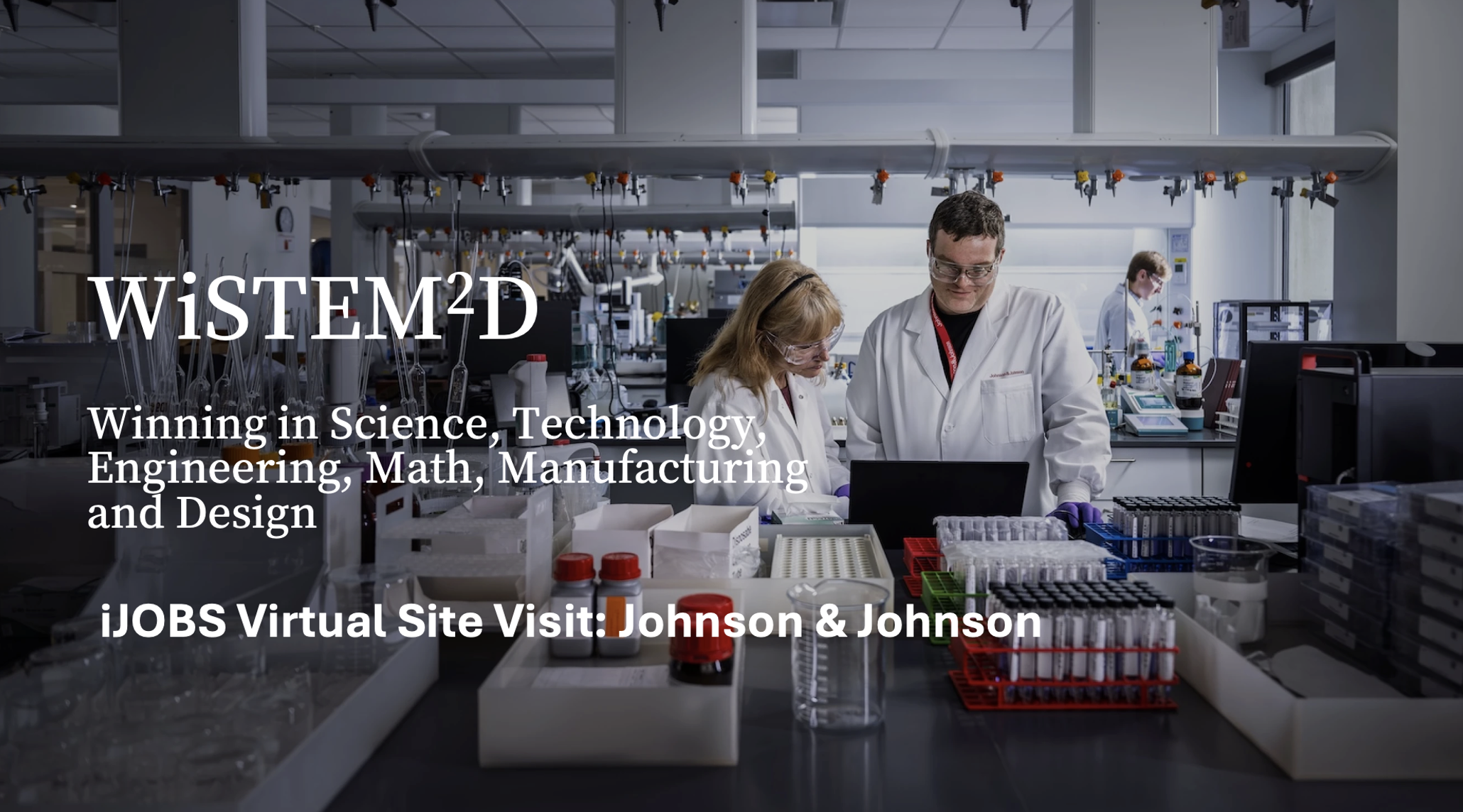
The pharmaceutical industry offers a wide range of career opportunities for graduate students and postdocs. Navigating these opportunities can be daunting, so Rutgers iJOBS partnered with Johnson & Johnson (J&J) to host the WiSTEM2D panel series featuring professionals from J&J who shared their career trajectories and personal experiences transitioning from academia to industry. They also offered helpful guidance on navigating the job application process. This blog post covers their careers and advice for PhD students and postdocs interested in pursuing a career at J&J or in the broader pharmaceutical industry.
Dr. Andrea Stevens, Senior Director in Precision Medicine Access at J&J Innovative Medicine, started the seminar by detailing her diverse professional background. Dr. Stevens received her PhD in Transplantation Immunobiology at University College London before starting her first position in Scientific Affairs at Quest Diagnostics. At Quest Diagnostics, she studied clinical trial protocols for laboratory managers, explained various testing strategies to Business Development teams, and led a team of scientists while partnering with pharmaceutical companies to ensure patients received the most appropriate treatment. Afterward, she transitioned to WG Consulting as a consultant. What was intended to be a short-term opportunity evolved into a full-time position as Director of Value and Access. This was a focal point of Dr. Stevens’ discussion, as she encouraged students to consider short-term roles as potential career catalysts. As a consultant, Dr. Stevens studied the precision medicine market and used this knowledge to apply for a position at J&J.
At J&J, Dr. Stevens and her team analyze diagnostic data to demonstrate the value of diagnostic testing—a collaborative effort involving patients, stakeholders, payers, physicians, and laboratory staff. Her team also oversees cross-functional teams and strategic alignment across global brands, Business Development, R&D, and regulatory functions. Reflecting on her journey, Dr. Stevens highlighted the importance of staying flexible and open to new career opportunities, leveraging networking and one’s online presence, and actively seeking mentors and champions who can advocate for career development and success.
Following Dr. Stevens, Dr. Rajesh Arasada, a Senior Data Scientist at J&J, shared his career journey from wet lab research to data science. Dr. Arasada worked in biochemistry, cell biology, and molecular genetics laboratories in Germany and at Yale University. He pivoted to data science after discovering his passion for coding at a programming camp at New York City Data Science (NYCDS) Academy. At J&J, Dr. Arasada analyzes big data to identify patients’ unmet needs and pinpoint physician collaborations to improve therapy delivery. In addition, he analyzes commercial data to inform critical business decisions. While explaining his transition from wet lab to coding, Dr. Arasada encouraged students to explore diverse career opportunities beyond the confines of their PhD research.
Another data scientist at J&J working as a GenAI Product Manager, Dr. Chang Zhang, had the opposite experience leading up to his position at J&J. Dr. Zhang worked on deep learning in computational materials during his PhD at the University of Minnesota. After completing his PhD, he joined Blue Cross Blue Shield as a Data Science Consultant, where he gained extensive experience in healthcare data analysis. This served as a key steppingstone to his subsequent position at J&J. As a GenAI Product Manager, Dr. Zhang acts as a crucial liaison between the Medical Affairs and Technology teams. He focuses on developing GenAI-powered tools to enhance medical content research and creation, including enabling more efficient literature searches, assisting with publication composition, and identifying new business needs. Dr. Zhang emphasized the importance of actively exploring industries like pharmaceuticals early in one’s career rather than focusing solely on academic publishing. He also highlighted the value of building personal networks and remaining open to opportunities outside of one’s primary research domain.
Dr. Yoliem Miranda Alarcón, a Senior Scientist in Drug Product Development, highlighted the importance of pursuing different translational topics after earning a PhD and encouraged students to develop diverse technical and interpersonal skills during their graduate training. Dr. Alarcón earned her PhD in Biomedical Engineering at Rutgers. During her time at Rutgers, she interned at a biotech hedge fund, where she observed mergers and acquisitions and learned how startups, mid-sized, and large pharmaceutical companies develop using different strategies. She also worked as a student scientist at GlaxoSmithKline studying pharmacokinetics and pharmacodynamics. This experience solidified her decision to join the pharmaceutical industry after graduation.
At J&J, Dr. Alarcón leads drug engineering and design and communicates with contract manufacturing organizations to coordinate mass production. Although her background was in tissue engineering and biomaterials, she has since developed expertise in monoclonal antibodies, CAR-T therapy, and ultra-high-concentration drug delivery while working in drug product development at J&J. She is currently pursuing an MBA in Business Analytics at Villanova University to gain finance and management skills that will complement her STEM background. Dr. Alarcón concluded by sharing key takeaways from her career: actively seek mentorship from professionals in your desired field, stay involved in professional organizations, embrace continuous learning, and always be respectful, humble, and confident.
The final speaker, Dr. Shereka Banton obtained her PhD in Biomedical Engineering at Georgia Tech with a focus in science and technology policy. Her time in the Medtech Scientist Mentoring & Diversity Program (SMDP) enabled her to network with Regulatory Affairs professionals across various pharmaceutical companies, including J&J. With her background and strong interpersonal skills, Dr. Banton was referred to the Regulatory Affairs Leadership Development Program at J&J. This led to her current position as Associate Director of Regulatory Affairs at J&J MedTech, where her team oversees product launches and the global distribution of surgical devices. They manage regulatory submissions and documentation that explain J&J’s practices and processes to ensure products meet global safety and effectiveness requirements. They also partner with other medical technology companies, such as Becton, Dickinson and Company, to co-develop projects like wearable devices and improve surgical hemostat availability. Dr. Banton emphasized that students must learn the vocabulary used in industry, such as “product development,” “process development,” “stakeholders,” and “cross-functional partners.” Using this specific language during interviews helps students smoothly transition their mindset from an academic lab to an industrial setting. She also reiterated the crucial need for networking and staying open to a wide range of job opportunities.
After learning about the various career paths and success stories from the panelists, the iJOBS seminar concluded with a Q&A session. Here are some of the highlights:
Q: Would J&J sponsor an international employee for an H-1B visa?
A: J&J sponsors H-1B visas for employees with a PhD. Although J&J may filter candidates based on their immigration status, there are numerous opportunities to join through alternative training and postdoctoral programs. J&J offers structured postdoctoral programs for professional development that can transition into full-time roles. More information can be found on the Careers at J&J website, and students can also apply to join the J&J Global Talent Hub for the latest job postings.
Q: What job titles should PhD candidates and postdocs apply for?
A: Specific titles vary by company. For example, “Clinical Trials” may be referred to as “Medical Operations” at different companies. Therefore, it is important to research how each company structures its departments. Typically, “Associate Scientist” is considered a non-PhD–level role, while “Scientist” positions are considered PhD-level. When applying for jobs, it is advisable to remain open-minded and explore opportunities in departments beyond R&D.
Q: What skills should graduate students develop through their PhD to prepare for the job market?
A: Problem-solving, networking, and teamwork were among the skills mentioned. Ultimately, a PhD is about both the research you conducted and your personal development as a scientist.
Dr. Stevens, Dr. Arasada, Dr. Zhang, Dr. Alarcón, and Dr. Banton shared invaluable advice for applying to jobs at J&J and within the broader pharmaceutical industry. Their career journeys and insights during the Q&A session greatly enhanced my understanding of the pharmaceutical industry. As a final remark, they reminded us that while the job market can seem narrow and highly competitive, opportunities present themselves to those who remain open-minded. It was an encouraging reminder that adaptability often opens doors in competitive fields.
This article was edited by Junior Editor Janaina Cruz Pereira and Senior Editor Antonia Kaz.